Tuesday, May 31, 2011

My Poor Attempts at Poetry Over the Years

These are two poems I composed close to 19 years ago, both of them while I worked at Chase.  The first is about a co-worker by the name of Raquel Aziz I worked with then.  Raquel was originally of Trinidadian origin, and she loved to eat a tone of garlic on her food which often stunk up the office!  Her co-worker, a sweet church lady we called Miss Grant, used to spray a ton of air freshener around while Raquel would indulge in her garlic-laden feasts.  She is referenced here as well, so enjoy!

The second is about another co-worker named Mark, who after indulging a few Coronas one weekend claimed he saw a dancing cow on South Beach.   My guess was that a Chick-Fil-A was close by, and it was probably a guy in a suit doing a promotion on the beach, something a slightly-tipsy beachgoer might not quite comprehend at the time.  

Ode To The Garlic Queen

Lest you catch a pungent reek
When the lunch hour peaks
The Garlic Queen has come!

Nostrils contract and olfactories shrink
When her dish eeks forth its stink
Then those around her start to pray
That the Lord provideth an air-freshening spray

As forth the pungent aroma blasts
One can feel the churning of gastric gas
She calls everyone a "Pooch"
But the air around her is as intoxicating as a cheap hooch

Mama sits with her spray can
Pleading to the Lord that some brave man
Would enforce on those pungent bulbs a ban
Oh, Allium Tricullum what is your appeal
That with you the Garlic Queen smothers her meal?

This little verse is an alarm
Lest your nose be assaulted with the pungent balm
Hail,oh Queen of rancid herb
Eat heartily of the meals you serve
But please have mercy on our olfactory nerves!

The Dancing Cow

My faculties were out of reach
when on an outing I went one night
I wandered down to the beach
and beheld myself a sight!

With black and white patches on its form
it danced in the pale moonlight
A large figure that wasn't quite the norm
did a Texas Two-Step - what a fright!

The bovine was enraptured in its dance
I could not believe my eyes
I thought that I was in a trance
that my senses were telling me lies

Today I swear I saw that cow
But no one will take my word
I still try to figure out how
that beast could kick the dirt

V-8 and Alka Seltzer did not suffice
as that vision still captures my whim
Perhaps the sun was more than strong
the day I beheld a beast so prim.


Tuesday, April 19, 2011

The Purple Trees of Easter


April is here, life is coming back to the earth, and spring has arrived!  In the part of Florida we live in, it means that one very important event that happens once a year is in full swing - the area is awash in trees that are covered in purple.  I have been enchanted with these beautiful trees for a number of years but never knew what they were called until a co-worker told me a few years back that they are jacaranda trees.  Always in time for Easter without fail, they burst forth in a blaze of purple glory for about a month, after which the blooms drop off and the trees blend back in with the rest of the foliage until the next year comes around.  

Although some people think jacarandas are a nuisance due to their being a non-native species (they were brought over from Brazil), they have become one of my favorite flowers, and sort of fill the gap left by a lack of lilac trees here, which I was used to growing up.  And, unlike wild boars, snakeheads, and kudzu, the jacarandas are not invasive; actually, they enhance the beauty of the area, which is constantly being built up as some greedy businessman builds yet another Publix, Stabuck's, or McDonalds (as if we don't have enough).  Therefore, I say celebrate their presence and enjoy their beauty for the brief time it displays itself every year.

Another phenomenon is something Barb pointed out to me that I had never noticed before I met her, and it involves another type of tree, namely evergreens.   At around Easter, the pine trees in particular display little crosses at their tips, and it is really a unique thing that only you can see that time of year.   Could it be that nature affirms something that man is often too selfish and blind to see?  Who is to say.   Anyway, with it being Easter season and all, thought it was worth mentioning.


A third interesting phenomena is something I grew up hearing about as a kid, and it involved the dogwood.  Legend has it that dogwood was chosen by the Romans as wood for the Cross that Christ was crucified on, and as a result God blessed the dogwood with a cruciform flower with patterns like a blood stain.  The dogwood is said to have its pink color also because it blushes in shame about the fact that it was used for what it was used for.  A song was made about this, and the story is still told by those who fondly remember it.


Creation indeed does herald God's glory, and it also commemorates Christ's Passion.  These simple signs from nature should serve to remind us of what we celebrate Easter for. 

I look for the day when my tired eyes see
the glory and beauty of the purple tree
Brief though it stays
it brightens the mundane days
As it breaks out in all its glory
as a reminder of God's redemption story!

May you all have a blessed Easter season.

Monday, April 4, 2011

David's Church History 101 Part 2 - MORE Interesting Groups

This has proven to be a longer story than I had anticipated, being I was hoping to get this all into one article!  However, there is so much more to talk about, and therefore I want to share some more interesting groups.

Back during the years 1990-1992, when I attended the old Florida Baptist Theological College in Graceville, FL, I had just received the Pentecostal Baptism on June 21, 1989, and many of the Baptist churches in the area really held no interest for me.  Although by then I had affilliated with the Foursquare denomination, the nearest Foursquare church was over 20 miles away in Midland City, AL, and although I would eventually be an active member there, at first it was not that convenient to go every Sunday.   So, I attended usually the First Assembly of God in Graceville on given Sundays, until I met my future wife Barbara.   Barb, like me, had started out Baptist as well but had gotten the Holy Spirit Baptism, and she was in a lot of ways more Pentecostal than I was then!  Any rate, she started going to another little Pentecostal church in Graceville called the Graceville Community Church, and it was actually a very old-time Holiness/Pentecostal church that reminded me a lot of the churches back home in WV.   As I attended the Graceville Community Church (especially its campmeetings in the fall, which were very good!) I began to understand that it was part of another Pentecostal fellowship, and therefore I wanted to find out who they were part of.  So, years later, I did, and it turned out to be an interesting group.

The new campmeeting tabernacle at Graceville Community Church, Graceville, FL, when we last visited there in August 2008.  The church house is to the left of the tabernacle out of range of the photo.

Graceville Community Church belongs to an association of old-time Pentecostal congregations called the Living Word of Faith Fellowship, based out of Panama City Florida.  According to the Fellowship Minister's Handbook,  the Living Word of Faith Fellowship was founded in 1954 through the evangelistic efforts of Rev. J. W. Hunt, a former Assemblies of God evangelist who established the Springfield Community Church, the "mother church" of the Living Word of Faith Fellowship, in 1951 in Panama City.  Although Rev. Hunt died at the age of 81 in 2001, his Fellowship is still vibrant today.   As of their 2008/2009 Ministerial Directory, they have approximately 92 churches as well as 205 credentialed evangelists and 8 missionaries serving in Chile, the Phillipines, Jamaica, Haiti, India, Peru, and Kenya.   Additionally, they have 4 campgrounds (Caryville, FL; Ellisnore, MO; Locust Grove, AR; and at the home church in Panama City, FL) and a periodical magazine.  Their churches are located largely in the states of Florida (the Panhandle primarily), Alabama, Georgia, and Mississippi, although they also have many fellowships in other states as well. Evangelists affilliated with the Fellowship can be found nationwide (one is even in Springfield, WV, close to where I spent most of my childhood in Kirby!), although the majority of them are in the core region.  Doctrinally, they are traditional, conservative Pentecostal/Holiness, and believe in modest dress, total abstinence from alcohol, tobacco, and other substances, and although stauch in their convictions, Resolution 5 of their By-Laws states that they acknowledge fellowship with all Christians who believe in the "Blood of Jesus Christ" and don't hold to any heretical doctrines.  These churches do uphold that, as often at their campmeetings they do often have speakers from other fellowships, and they maintain a cordial relationship with other churches of different denominations in their respective communities - the Graceville Community Church is a good example of this, as they had a strong impact on many students at FBTC back in the day, and their pastor then, a capable preacher and talented gospel musician by the name of Tommy McCormick, on occasion even spoke in the college chapel services.  They are also a very expressive group, and music ministry plays a big role in their church service and campmeetings as a number of talented musicians hold ministerial credentials with the Fellowship.  Again, I have found over the years that the Living Word of Faith people were by and large a strong and sincere group of fellow believers, and I greatly respect them because they are one of the few fellowships today keeping alive the "old-time Pentecostal faith" that I fondly remember as a kid. 

A second group, intimately tied to the Holiness Messenger paper out of Oklahoma, is a conservative Pentecostal/Holiness fellowship based out of Ohio called the Free Pentecostal Church of God Association.   With congregations simultaneously called "Free Pentecostal Holiness Churches," this fellowship is based out of the Pentecostal Holiness Tabernacle in Cincinatti, OH, and many congregations in fellowship with it can be found in the upper Ohio Valley region.   Not much is known as to the history of the group, as it is a more informal fellowship, but they do have a website (http://www.freepentecostalchurchofgod.com/) and many of their congregations are listed in the Holiness Messenger as well with contact information.  Another valuable resource that would shed light on these churches, but is hard to find, would be Richard Crayne's Pentecostal Handbook, which is the first history of its kind on the independent Pentecostal/Holiness churches.  However, by what I can gather, this fellowship and others developed around about the late 1960's and early 1970's from many disaffected ministers in the Assemblies of God, Church of God, and other mainstream Pentecostal groups, out of a growing concern that the latter groups were being too modernized and worldly.   In a sense, many of these churches also would identify as "fundamentalists" too, being they are staunchly conservative and accept a lot of dispensational premillenialist eschatology.   They are also very much Holiness too, as they mandate strict standards of conduct for their membership.  There are two other related groups to these I will discuss now, as they are part of the same movement.

Both of the bodies I am about to talk about are two distinct fellowships with no direct relation to each other but are similar in belief as well as sharing the name "Free Holiness Church."   The first of these is a group that appears to be centered in northern Alabama, with 69 congregations scattered across Alabama, Georgia, Tennessee, Kentucky, Mississippi, Florida, and North Carolina.  They have a Holiness Network website at http://www.freeholiness.net/,  and from 1972-1990 they published a periodical called Glad Tidings, the many issues of which can be read online at the website given.  I have some other information on this group somewhere, and perhaps in the future I can provide more.   The second group of Free Holiness congregations, as I can gather from the Holiness Messenger website, have 9 congregations with the specific Free Holiness name centered in the Midwest and West Coast.   This group is in active fellowship with the other fellowships who cooperate with the Holiness Messenger paper, and there may be more churches of them as well.  I am really hoping to find out much more about these groups later on, but small Holiness/Pentecostal groups are not exactly noted for record-keeping unfortunately, as they often don't place great priority in it. 

Another similar group to these is the Bible Holiness Ministerial Fellowship, which was founded in 1998 in Charlotte, NC, where the current overseer, Pastor Joseph Chambers, resides.   They are similar to the other groups who cooperate in the Holiness Messenger, and like so many other conservative Holiness/Pentecostal fellowships, they were founded by disaffected ministers of mainstream Pentecostal groups who became disillusioned with the direction many bigger groups such as the Assemblies of God were taking.  They too uphold traditional Holiness/Pentecostal standards, and are located largely in the states of VA and NC.   The exact number of churches is not available on their website, but they do maintain missionary projects in Mexico, the Dominican Republic, and Haiti.   They also have evangelists, periodic campmeetings, and are in full cooperation with like-minded fellowships.

That pretty much sums up some of the old-time Pentecostal/Holiness groups I have encountered over the years and no doubt there are more.  However, it is important that I spend a little time talking about my own church, the Synod of Saint Timothy, a little.

The Synod of Saint Timothy is basically a small independent Catholic fellowship founded in 2007, and it represents what is called a "Primitive Catholic" faith, meaning a complete return to the way the Church was operated in the first few centuries after Pentecost.   With my own background in a charismatic/liturgical movement called the "Convergence Movement" back in the mid-1990's, this group was what I personally was looking for.   Congregations are in several states (Texas, Georgia, Indiana, Tennessee, and Ohio), and a number of different rites and liturgies are followed.  My bishop, Paul Stanley of Rome, GA, pastors the All Saints parish there, and his wife Susan (Sr. Brigid) and he lead a semi-monastic life.  Another of our bishops, Mar Michael Abportus (Michael Thannisch), has a very unique parish in LaPorte, TX called B'nai Avraham, which follows a Hebraic/Syriac tradition.   Bishops Paul and Michael are both wonderful leaders and ministers, and I have the honor of knowing them both as brethren in spirit.  For more on the Synod, go to http://www.christiansynod.org/.   Where we live in Florida now, there is no Synod mission, so Barb and I actually attend a local Anglican Catholic parish, St. Philip, and it is similar in faith.  One day maybe we can have a mission near us to actively participate in, but it is going to take time to establish a witness for our fledgling Synod, but we have quality leadership so it is definitely possible.  I also want to mention that our Synod is made up of many former Pentecostals and nondenominational charismatics, and those of us from those backgrounds still very much believe in the present ministry, signs, and gifts of the Holy Spirit, and we are also staunchly conservative in belief. 


My bishop, Paul Stanley, of the Synod of Saint Timothy, holding an outdoor liturgy at the monastic retreat they have at their residence in Georgia.


I hope this will introduce many of you to some of the small churches and fellowships I have encountered that have fascinated me over the years, and should you live in an area where any of the congregations of these fellowships are, be sure to pay them a visit some Sunday - they are all pretty much down-to-earth and sincere folks, and would greatly welcome your visit.  And, as for visits, thanks again for paying me a visit via the written word this week, and hope to see you again soon.  God bless.

Tuesday, March 29, 2011

David's Church History 101 - Interesting Religious Groups I Have Encountered Over The Years

Last night, I had a very nice 3-hour conversation with a Tennessee pastor by the name of Jimmy Morrow.   With a small congregation in the town of Newport, TN, called the Edwina Church of God in Jesus' Name, Jimmy works a day job while pastoring his faithful flock.  Now, Jimmy may seem to some like another rural Holiness/Pentecostal pastor, which he is, but Jimmy's church has received a lot of media attention due to one important aspect of their faith that makes them a little different - they "follow the signs," as Pastor Jimmy calls it, based on a passage of Scripture found in Mark 16:15-20, and a portion of that passage says this - "and they shall take up serpents..."  Yes, Pastor Jimmy is a serpent-handling Holiness minister.  He is one of several I have come to know over the years as friends and even prayer partners, and although I don't personally advocate picking up rattlers as led, at the same time I have gotten to know these folks as people and have come to appreciate and admire them.  Also, they are like myself fellow Appalachian-Americans, and that means something too. 

Although limited educationally, Pastor Jimmy is by no means some illiterate hick - he is actually very intelligent in his own way, and has amassed an archive of very valuable information not only on Signs Followers, but also on his local history, his family tree, and on a lot of the history of Holiness movements in his part of Tennessee.   And, he has actually written a book entitled Handling Serpents which serves as more or less an official history of his particular Holiness tradition - I might add that this book is the first ever to be written by an actual adherent to the serpent-handling faith, and thus it is valuable because it is written by one who lives the religion rather than an outside observer.  In my opinion, Jimmy may not have a doctorate, or may not be recognized by any academic establishment, but he is a true scholar and historian just the same; he has truly taken the Scriptural mandate to "study to show thyself approved," and in some aspects he has a lot more brains even than many who have a lot of degrees adorning the "I love me" walls of their homes and offices.  And, I count it a privelege to have him as a friend, not to mention have enjoyed talking to and getting to know him as a human being (of which he is a fine example, I might add).

Serpent-handling has fascinated me personally not only as a native Appalachian-born Christian myself, but also it is something that, I must admit, gets my attention because it is so unique as a Christian tradition.  And, over the years I have read almost all the books on the subject, having my own copies of most of them in my personal library, as well as seeing a lot of film footage, etc.   However, I open this story not to talk about serpent-handling churches, as enough has been said, and therefore this is not a historical dissertation on the serpent-handlers - if you want those, read Pastor Jimmy's book as well as many other fine volumes out there, but especially his, as he is the most qualified as a part of his tradition to tell you about it, more so than I am.   However, there are literally hundreds of little fellowships of churches, associations, conferences, and small denominations in the US, all having a unique history, and I am doing this to introduce you to a few of them that have fascinated me over the years.   Some of them are regional churches - they are small groups confined to a certain geographic area.  Others are a little larger and have congregations all over the country, but they still carry a fascination for me.  And, that is what I want to talk about here. 

Church history is one of my favorite subjects - heck, history in general is interesting to me!  However, the histories of large mainstream groups are often too cumbersome, too extensive, and too boring in many cases to deal with, and generally I know all about the "big fish" anyway because their histories are readily available (there are now at least 6 books on the history of the Assemblies of God at this writing, just as an example, and the Southern Baptists have a whole set of encyclopedias dedicated to their story!).  What really fascinates me though are those little groups, some with unique origins and only found in certain places, and it is those I devote a lot of my research to.  I owe a lot of good people in those groups a great debt of gratitude, because many of them have provided some very rich resource material that I am using here now.   So, without further chitter-chat, let's begin.

One of the first groups I want to talk about doesn't have a lot of information available on them, but they go back a long way in my personal history.  Back when I was in high school, we lived in the town of  Terra Alta, WV, and on a small rural road just outside town called Salt Lick.  If you traveled due south on Salt Lick Road, it would lead you to the town of Rowlesburg, where I had a lot of deep roots (Rowlesburg is the location of the little Southern Baptist church where I was led to Christ in 1986, and also a home to our family for many years).  Before crossing a rickety bridge that took you into Rowlesburg, spanning the railroad tracks that converged on the town from the north, on the left side of the road was a high slope, and overlooking that rickety bridge was a tiny Pentecostal church that met in a prefabricated home the parishioners had converted into a church.  Back in the day, the Rowlesburg Pentecostal Church was pastored by Rev. Lawson Henline, who I believe was also the founding pastor.  I remember when I was in my junior year of high school that the Preston County News, our weekly paper, published some biographical information on Pastor Henline, and one of the things they mentioned was that he had recently been appointed a bishop in a small fellowship his church was part of.  I racked my brains for years trying to find out what the name of the group was, and recently I found it.  The Rowlesburg Church belongs to a tiny "Jesus-Only" Pentecostal fellowship, headquartered in Friendsville, MD, called the Emmanual Apostolic Church.  And, they are small - their website, www. eaciorg.com, lists only 7 congregations in their fellowship, with two in Maryland, 4 in West Virginia, and one in Ohio.   It was a great boost to finally find out who these people are, and I know just by the length of time the Rowlesburg church has been there the Emmanual Apostolic Church at least has a 35-year history, possibly longer.   It is unique in the groups I am discussing here because it is the only one that is part of the Oneness Pentecostal movement.  I personally don't agree with the Oneness view, because it is not compatible with the teachings of the Church, but at the same time I don't think they are some cult either - the ones I have met are very much Christians actually.  To make that point, this group has a lady evangelist, Rev. Leona Stepp, who is one of the most godly people I have come into contact with, and years ago some good friends of ours in Kirby, WV, introduced us to her ministry as she recorded an album of gospel songs.  Although now aged, as far as I know she is still alive and in Ohio, and I was able to have the privelege of talking to her a couple of years back.  As for Bishop Henline, he passed on some years back, and the church is now under the pastoral leadership of Pastor Franklin Hixenbaugh. 

The next group of churches are a denominational family with common roots, as all of them are geographically centered in southern Georgia and northern Florida and they are Pentecostal Baptists.  The first, and oldest group is the Holiness Baptist Association, which has its current headquarters just outside Douglas, GA, where they maintain a campground.  The Holiness Baptists got my attention back around 1988 or so when I was spending the summer at my dad's place in Brunswick, GA.  Looking through the local paper, I centered on the church ads and came across this church called the Antioch Holiness Baptist Church.   At that time, I was still a Southern Baptist myself, and this whole idea of Baptists being also Pentecostal fascinated me, so I had to find out more.  So, the following summer, I went to Dad's in order to work after graduating high school and save up some cash for my first semester of college, and at the time I began to attend this little Pentecostal Holiness church up the road from Dad's, where on June 21, 1989, I received the baptism of the Holy Spirit with evidence according to Acts 2.  The lady pastor, Sister Mayfield, of that church was raised in the Holiness Baptist church, and she told me a little about it and then introduced me to one of their local ministers, Rev. Phillip Popwell.  Pastor Popwell served as an associate minister at the Antioch Church in Brunswick, and after a pleasant conversation with him, he sent me a copy of their Associational minutes for the 1988 year.   This proved valuable, and I have that copy in front of me now as I mention them.  According to the minutes book, which on the first page provides a brief history, the Holiness Baptists came into being when some local Missionary Baptists began to embrace the Holiness and later Pentecostal message.  Some of the churches, as a result, were expelled from the local Baptist association, called the Little River Association, in 1893, and in October 1894 they organized the Holiness Baptist Association in Wilcox County, GA.  As of the 1988 figures that I have in front of me, the Holiness Baptists had approximately 29 churches, scattered across southern Georgia as well as a church in Florida, and they had around 929 members.  Of course, that may have changed, as I am aware that the Antioch Church in Brunswick for instance doesn't seem to be showing up anymore in any research, meaning it could have been closed.  Nonetheless, the Holiness Baptists are still a small but vibrant fellowship, and I see a lot of their participation with other Pentecostal groups in revivals, etc., in a small paper I receive every other month or so called The Holiness Messenger.  My hope is that they continue to be a strong fellowship.

Like many religious groups, over the years schisms happened, and the Holiness Baptists were no exception.  One such break came in 1934 when a new group, called the Baptist Purity Association, was formed over the issue of using water rather than wine or juice in communion.  This is another group I had to find out more about, and finally in 2008 I was able to get in touch with one of their elders, Rev. Bobby Joe Hires, in Salem, FL, who sent me a large package with a number a wonderful and valuable resources on the Baptist Purity folks.  One of the books Pastor Hires sent me was a book written by his sister-in-law, Ida Turner Guitterez, entitled Sawdust Trail.  A small GBC-bound self-published book she wrote in 1987, it is the biography of her father, Rev. Luther Turner, who was more or less the founder of the Baptist Purity Association.  Turner, born in 1888, was born just outside Abbeville, GA, and grew up in a poor sharecropper family there.  Although a bit wild and unruly in his youth, Luther Turner was converted to Christ sometime in his teens around the year 1905 or so, as I reckon it from Ida's book on page 3, and although his conversion was not solid at first, he was born again under the ministry of an itinerant preacher by the name of Evangelist Clarence D. Cooper and soon after accepted a call to preach.  In time, he came to be identified with the Holiness Baptists after a short sojourn in the Church of God.  After moving to Perry, FL, around 1924, Turner later faced some opposition from both the Church of God and Holiness Baptists, Turner founded the Baptist Purity Association in 1934.  In belief, the Baptist Purity Church is a little more conservative than its Holiness Baptist forebears, and according to their Church Discipline they use only cold water in their Communion services, and strictly forbid the use of alcohol, tobacco, as well as gambling, and worldly entertainments are frowned upon.  The group also practices footwashing, believes in the Pentecostal experience, and they dress modestly.  As of their 2007 minutes, they have 8 congregations, with 6 in Florida and 2 in Georgia.  Their main "mother church" is in Salem, FL, and they have quarterly meetings.  Their current Associational Moderator, as of 2007, is Bobby Joe Hires (founder Luther Turner's son-in-law), who also graciously provided the information.  Fortunately, one of their congregations is very close by, in Plant City, pastored by Rev. Richard Joyner, and I am hoping to visit there sometime in the near future and formally introduce myself to these good folks.


Baptist Purity Church congregation in Abbeville, GA


A second break in the Holiness Baptists happened in 1977, when a group near Broxton, GA, formed the Calvary Holiness Association.  According to the Wikipedia article, they have about 17 churches and just under 500 members.  Although quite visible and actively involved in fellowshipping with other groups, the Calvary Holiness Association has been a hard nut to crack as far as getting information, despite a couple of calls to their campground headquarters in Broxton, GA.   Maybe in the near future I can get more information, including some history and minutes books on them.   Another schism occurred among the Baptist Purity folks in the 1940's, when one of their ministers, Rev. Riley Pridgeon, founded and evangelistic association up around Perry, FL and his church there, Antioch Revival Center.  Little is known about this group,  although I continue to research it.   Any rate, this is the basic family tree of the Holiness Baptist tradition in south Georgia.

A second group of Pentecostal Baptists that fascinates me evolved out of the Falcon, NC, revivals of  G.B. Cashwell, a Pentecostal Holiness evangelist.  The Piedmont region of North Carolina had been for a couple of centuries a strong center for FreeWill Baptists, and many of them, due to their Arminian theology, were impacted by the Pentecostal revivals of Cashwell in Falcon.   The major group of this movement, at least today, is the Pentecostal Free Will Baptist Church.  Founded in 1959, it has about 28,000 members in over 150 churches (as of 1998, according to the Wikipedia article on the PFWBC), the majority in North Carolina but also with congregations in Virginia and South Carolina as well as about a dozen or so Spanish-speaking congregations in Florida (including one, I was surprised to find out, here in Tampa!).  Being it is a lot more mainstreamed as a church body, I am not going to devote a lot of space here to this group but rather to some interesting sister groups that came out of the same heritage.

The South Carolina Pentecostal Free Will Baptists, much more conservative in doctrine, formed the Free Will Baptist Conference of Pentecostal Faith at around the same time the NC congregations organized the PFWBC.  This South Carolina group is still vibrant today, and still very old-fashioned in their Holiness ways, and consist of about 20-some churches, mostly in South Carolina, and their headquarters in Turbeville, SC, just east of Sumter.  To me, they are the more faithful of the two groups.  Another group with similar heritage is the Trent River Freewill Holiness Association, headquartered in Clinton, NC.   This conference was established in 1946 by Rev. Ruben Jones, a Pentecostal Salvation/Healing evangelist with Free Will Baptist roots, and today his granddaughter, Dr. Teresa Ammons, is the current overseer.  They have a simple but informative webpage at http://www.freewillholinessassociation.org/, and around 17 congregations centered in eastern North Carolina.  I am indebted to Rev. Elmer Parker, of Hairs Chapel Freewill Holiness Church in Linden, NC, for his gracious assistance.  A third group connected with this tradition is the General Conference of the Evangelical Baptist Church, which was at one time centered around Goldsboro, NC but was recently resurrected in Arizona as a fellowship.   Although originally founded in 1935 under the leadership of Rev. William Howard Carter as part of the same Holiness outpouring that produced the above groups, the GCEBC developed a whole unique history.  It declined in the early 1990's and was recently rebirthed by a group in Arizona, where it is now headquartered.  No recent stats or other information are currently available, although they do have a website at http://gcebaptistchurch.com/aboutus.aspx in which their Discipline and other documentation are readily available.  I also have a copy, from the late 1980's, of their old Discipline as well from the original conference.  This is definitely a group to keep an eye on as it develops.

Another elusive group of churches, related to these other Pentecostal Free Will Baptists, are a group I note as "Free Will Baptist Holiness Churches."  Due to the fact that many of the dozen or so of their churches throughout the Carolinas I have researched has the title "Saint" in front of them, I surmise that these may possibly be African-American Pentecostal Freewill Baptists.  Thing is with them, unfortunately, are many unanswered questions - do they have a conference? Is there any historical information on any of their congregations?  I hope to find answers to all that in the near future.

Another group of Free Will Baptists, these being non-Pentecostal but Holiness in emphasis, came into being in 1931 in the foothills of southeastern Ohio.  They represented a conference of Regular Baptist churches and a conference of Free Will Baptists who became influenced by the Keswick expression of the Holiness movement, and called themselves the Christian Baptist Churches of God.   They are currently headquartered in Wheelersburg, OH, and have about 35 congregations scattered about Ohio, Kentucky, and West Virginia.  They still retain strong fraternal fellowship with the Free Will Baptists, and one of their ministers, Rev. Brian Baer, often speaks at campmeetings conducted by a very powerful Free Will Baptist evangelist from Rubyville, OH, by the name of Calvin Ray Evans.  I first came in contact with their Missions director, the late Mrs. Goldie Taylor, some years ago, and have been impressed with them since.  They are a very interesting group to say the least.

The Fellowship Christian Baptist Church, Grayson, KY


A final group I want to mention - there are others, but timie and space doesn't permit me at this time, although I may do a separate article on them - is a recent group of old-fashioned Holiness-Pentecostals that caught my attention a few years back.  These people are even more relative to me personally as one of their pastors was the son of my grandparents' late pastor in Parsons, WV.  In 1988, a minister of the Church of God (Cleveland, TN) by the name of Rev. Dollas Messer was part of an effort to restore the Church of God back to its Holiness roots, which many members saw was being compromised by more worldly expressions taking root in Church of God congregations.  The effort met with resistance due to the more modernistic bent of much of the COG's leadership, and many ministers chose to disaffilliate with the denomination.   A group of 54 faithful met, according to a copy of the WPC Manual  I received from my good friend Elder Daniel Rhodes (his father, Pastor Bill Rhodes, pastored a small independent Full Gospel church in my hometown of Parsons where my grandparents once attended), at Dollas Messer's home in 1989 and founded what would become the Wesleyan Pentecostal Churches.   Thanks to modern technology, I have managed to get some of Bro. Messer's messages on CD, and he is a powerful evangelist, and his son Micah has become a good friend via Facebook networking also.  As of late, the WPC has 3 churches - Fayetteville and Washington in North Carolina and Canton, GA - and I don't have any recent membership stats on them unfortunately.  My good friend Elder Rhodes pastors in Washington, NC.  In recent years, Bro. Messer has become a widely sought-after speaker for a variety of conservative Holiness/Pentecostal fellowships, and his ministry is characterized by a strong integrity and a steadfast faith.  This group does have a webpage at http://www.wpchurches.com/index.html, and all three churches do have an internet presence as well.  

If time and space permitted - I will add more in part 2 of this later - there are other groups I wanted to touch on too, including the Living Word of Faith Fellowship of Panama City, FL (the Graceville Community Church, in Graceville, FL, was part of this, and was a church my wife and I liked attending yearly campmeetings at - they are a larger fellowship but are good folks), two Free Holiness Church conferences (one in the central Appalachians, the other in the upper Midwest), and the Free Pentecostal Holiness Churches, which through an excellent publication called The Holiness Messenger (http://www.holinessmessenger.com/) have a solid network of old-time Holiness/Pentecostal churches and fellowships that can be found across the country (some conservative Church of God and Assembly of God congregations are also part of that network as well).  Although I myself am now an independent Catholic (I probably need to devote a section to the Synod of Saint Timothy, my jurisdiction, as well) I have strong ties to old-time Holiness churches, as that is how I grew up and I still carry some of those convictions today with me.   All of these interesting and unique churches fascinated me with their history, but I also have gotten to know many of their people too, and that has been a greater blessing in itself.  Therefore, when I pick up with part 2 later, I will talk about some more of these groups.  Have a good night, and God bless.

Wednesday, March 23, 2011

Thomas, WV and Tarpon Springs, FL - Similar Communities and Similar Enchantments

When I was growing up near my hometown of Hendricks, WV, there was an interesting community about 12 miles north called Thomas which always fascinated me.  Meandering up US 219 as it ascends Backbone Mountain, the high-elevation town of Thomas was a bit different than many towns in West Virginia.  Years later, when I moved to the Tampa Bay area, I discovered another similar community on the sea about 15 miles north of St. Petersburg called Tarpon Springs which evoked a similar enchantment.  Reason is, despite some differences in landscape and climate, both towns shared a similar history.  Let me share that with you now.

Thomas was founded in the 1880's as a center for the coal, lumber, and railroad industries, and when many immigrants started coming into Ellis Island at around the same period, many of them settled there leaving their mark on the architecture and culture of the region.  Even today, Thomas is basically an Italian community in the middle of the West Virginia highlands, and its old-world charm still enchants people who visit it from all across the US.


Top:  A view of Thomas from Backbone Mountain
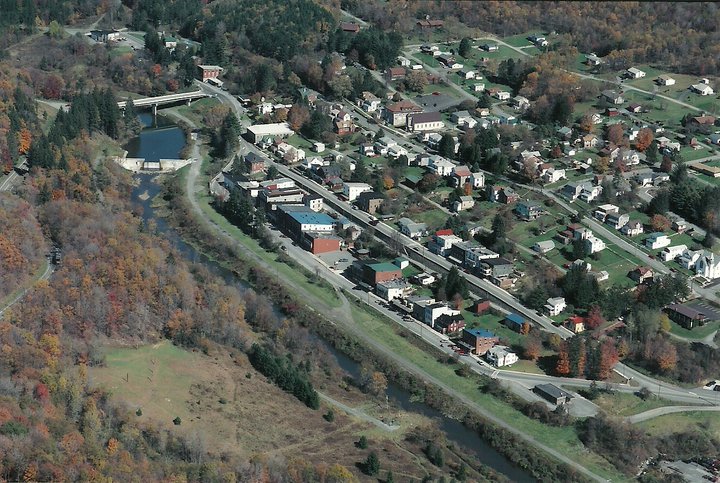
Bottom:  An arial view of Thomas looking northwest  with the Blackwater River in the foreground

Tarpon Springs also came into being at around the same time, and it had a slightly different story as a number of Greek immigrants found the area an attractive and lucrative location for one major commodity - sea sponges.   Today the majority of the residents of Tarpon are still Greeks, and they are still proud of their heritage and have created a new commodity today called tourism.   Since living here, Tarpon has become almost like a second home to us.

Top:  The famed Sponge Docks in Tarpon Springs
Middle:  Saint Nicholas Greek Orthodox Cathedral, Tarpon Springs
Bottom:  Greek boys diving for the blessed Cross on the Feast of the Epiphany in Spring Bayou, Tarpon Springs.  This is a yearly tradition.

Now that I gave you some background on both communities, let me reflect a little.  Whenever I visited Thomas as a kid, I always imagined it as a pretend-trip to Europe, as from the streets if you stopped to shop you could smell fresh-baking Italian bread, the tangy smell of a homemade pizza cooking (the secret was truly in the sauce - authentic Thomas Italian cooking used oftentimes a very special local ingredient, ramps, in their sauce, and it was delicious!), or even the sounds of opera floating out of the local shops.  Names over the businesses also gave them away - groceries owned by the DePollos and Colabrese families, a garage owned by the Genovese Brothers, etc.   It made you feel proud, although most of us from Hendricks were not Italians ourselves, because Thomas was not just Italian-American, but it belonged to us as a county, and it was uniquely Tucker County.  That is what made it more exciting.

Tarpon Springs is a little more tied to its traditions even than Thomas, because the Greeks there are still very much Greeks, although they too have made their contribution to Florida's history and heritage.  Whether it is the Santorinis or Papas families and their restaurants, or a prominent Florida Congressman who is a native son by the name of Gus Bilirakis, any visitor from Greece to America will feel right at home.  And the food...my goodness!!  Fresh baqlawa or souvlaki on a stick - delicious stuff!  I like going up there during Easter to get ingredients for our Paschal dinner, as it is one of the few places you can find the authentic stuff.  And, let it be said here - Greeks make much better pizzas than even Italians do (sorry to my Italian friends, as it's nothing personal).  Of course, mention must be made of what draws people there on January 6th every year too.  January 6 is the Greek Epiphany feast, and in Tarpon it is celebrated in a special way.  A visiting Orthodox bishop will celebrate the Liturgy (which is very beautiful) in St. Nicholas Cathedral, and at its conclusion he leads a procession that includes a number of adolescent boys in swimgear, down about 5 blocks to Spring Bayou.  Taking a large gold-painted porcelain cross, the bishop blesses it and tosses it into the water, at which time the boys dive in and scramble to retrieve it.  Once the lucky kid gets the cross, he is blessed by the bishop with a special blessing, and becomes sort of a hometown hero for that year.   I have yet to see that event, as it always falls when we have to work, but one year soon we will make it, I promise that!  That is more worth coming to Florida to see than Disney is, in my humble opinion.  In March, another big event happens too as a Greek Independence Day parade is organized and that too is something to see - I still have a set of blue-and-white beads, as well as two Greek flags, from our observance of that (to make the day perfect, having some souvlaki or roast lamb at Santorini's on the Docks is a good climax).

Being I am a bit tired today, I am unable to really get into this as much as I wanted to, but wanted to just share a thought because I saw some interesting perspective on these two diverse communities.   Will be back to visit you soon again, and my best to you for a good week and many blessings.

Monday, March 7, 2011

Thoughts, Thoughts...And More Thoughts!!

As of late it has been quite exhausting - work has been strenous (although I do thank God for the job) and my whole body has been sore.  Yet, a lot has been happening otherwise too, which is what I want to talk about today.

After a few months' hiatus, I am finally at a point to where I can get some of my Amazon wishlist cleared up, and it is quite an exhiliration to do that.  Recently, I have acquired some DVD's of my specific musical interests, but they are a bit different.  Among my newest acquisitions are DVD footage of two classic Gospel quartets, the Statesmen and the Blackwood Brothers.   Having grown up around a culture where Southern Gospel was quite popular, it would only make sense that I develop a taste for it.  And,  the talent of those quartets, man - their blend, harmony, and range are absolutely phenomenal, and that piano too; nothing like good Gospel piano!  If only I could play myself...hmmm!!

My love of the old gospel quartets and my big band interests are not exactly mutually exclusive either, and I often muse that if I would have lived in that era, I would have featured a Gospel quartet with my orchestra.  And, another thought quickly followed that - could you imagine if you could take four saxes - two tenors, a baritone, and a bass sax - and write arrangements of quartet favorites for them??  I think that would sound phenomenal myself - a sax quartet playing old "Redback" (the popular name of the old Pentecostal Church Hymnal published by Pathway Press in Tennessee) gospel songs such as Hovie Lister's "Goodbye World Goodbye," or an arrangement of the old Blackwoods' record of "Swing Down Sweet Chariot" (if you all get the chance, look up that latter one on Youtube or something, as it is a great recording).  It would sorta be a bit of an Adrian Rollini-meets-"Big Chief" Wetherington fusion.  Would be a great sound no doubt.


Bass sax virtuoso and bandleader Adrian Rollini


Jim "Big Chief" Wetherington, who for many years was the bass singer with Hovie Lister and the Statesmen

There was something too about those old Gospel songs - they were never meant of course for corporate church services, although many of them ended up being part of the standard hymnody of the Church later on.  However, they provided an outlet of Christian-based talent that gained the adoration of millions of fans.  Southern Gospel music today has lost a lot of what the older quartets had, and it is a shame.  Many of these new gospel groups are now flirting with CCM, which is to me both spiritual and artistic suicide.  Or, they sound too twangy and hickish - some originally gospel groups even sold out for the almighty buck, notably the Oak Ridge Boys, and that was a shame as well.  However, thanks to new technology, that great old music, like played by the Blackwoods and Statesmen (I am also a big fan of vintage Black gospel as well, and my favorite Black Gospel group from days past would hands-down be Clara Ward and the Ward Singers - fantastic stuff too!).

The old "Redback," a classic Pentecostal shape-note hymnbook published by the Church of God's denominational publishing house in TN.  This book has all the old classic gospel songs and spirituals the old quartets recorded and made famous, and many churches thankfully still use this classic hymnal today.


One thing I do miss seeing though is a program I remember watching regularly about 20 years ago on a local Christian television channel back home in WV.  The half-hour program featured gospel pianist Hilton Griswold who, back in the 1940's, played piano with the Blackwoods.  He still is around as far as I know, but I wonder if his shows are available on DVD - I really should research that.  He is a phenomenal pianist too, and much like Anthony Burger he exemplifies classic Southern Gospel piano. 

Gospel pianist Hilton Griswold

Any rate, the DVD footage of the vintage Statesmen and Blackwoods was a real blessing and treat to get last week, and have already watched them twice through!  For some of you people who are into the whole "American Idol" crap, it is time you learn what real talent is all about, and it would be an educational experience for you to hear great music such as this.  Southern Gospel and big bands will always be my music, and I would not have it any other way.   God blessed me with the affinity for this stuff for a reason, and I feel - as I may have said a time or two in the past - that it's a part of my testimony.   I could never in good conscience listen to rock music or anything that sounds like it - they play that junk at work way too much, and I get sick of George Harrison praising the Hare Krishnas, the Eagles extolling the virtues of the Church of Satan, and that pervert Prince doing God-knows-what in that acidy, stinky garbage of his from the 1980's.  And, please spare me the overly-commercialized and musically-deficient detritus as exemplified by that Bieber twirp and the whole "American Idol" franchise, not to mention their sellout CCM religious imitators - gag me with a spoon!!  American musical tastes these days have gotten as dumb as petrified owl dung, and it seems that every passing fan makes society even dumber; whatever happened to real musical talent anyway, seriously?? 

That is basically a nutshell expression of my thoughts for the week, and my apologies in advance if I am too crass and insulting - American pop culture as of late leaves me nauseous, so please excuse my rants.  And, God bless you until next time.

Monday, February 28, 2011

Some Random Thoughts - Ghost Towns From Back Home

What is it you think of when you see the term "ghost town"?  Nine chances out of ten, what probably comes to mind is some rickety old prospector town somewhere out in the Southwest buried by desert sand and assaulted with roaming spheres of tumbleweeds and guarded by saguaro cactus sentries.  If that is what you perceive as a ghost town, I have this to say - you have probably been watching too many "Bugs Bunny" cartoons on the Boomerang channel.  In reality, many parts of the country have these little places, and my home state of West Virginia is no exception to that.   Now, I want to introduce you to some of those places.


The Fairfax Stone as it appears today


About 14 miles north of my hometown of Hendricks, where western Maryland comes to a sharp point like an arrowhead separating the shoulder of the Eastern Panhandle of West Virginia from the rest of the state, the mighty Potomac River has its birthplace.  Near its headwaters is the famous historical marker called the Fairfax Stone, which was the place that Lord Thomas Fairfax, who originally owned much of the region as his personal fiefdom, marked the frontier of a territory that later came to be known as Augusta County, which at one time covered an area from the northern neck of Virginia to eastern Indiana.  It is from the headwaters of the Potomac that many of these little ghost towns start to appear, although they also can be found elsewhere in the region too.  By the time I came along as a child, many of these places were long abandoned, save the occasional farmhouse that some local family came into ownership of and by then was in that particular family for many generations.  However, at the dawn of the 20th century, many of these places were once prosperous communities.  I feel a historical booklet on the subject written in 1998 called Ghost Towns of the Upper Potomac (Parsons, WV:  McClain Printing) as compiled by the Garrett County (MD) Historical Society says it best as quoted from page 1 of the small book:

Most of these ghost towns can be identified, when one finally reaches their locations, by ruins of old buildings amid the brush, cement foundations of former bridges, other structures, and remains of coal tipples.  The real tombstones, however, are the large gob piles, partially hidden by tangled brush and scrub trees on the hillsides, that mark the coal mines taht once gave economic life to so many of these old towns.

Our trek to these old ghost towns is rather sad and we want to find where they were and by what names they were called.  For what purpose did they exist and what companies created them while mining the coal seams along this meandering river?  We look at these collapsed pit mouths and we wonder the price of human life paid to dig the coal that once poured from them into the railroad cars. 


Gorman, MD/Gormania, WV - one of the Upper Potomac ghost towns that is still a living community today


Douglas, WV, a mining ghost town just south of Thomas, 14 miles north of my hometown of Hendricks


Jenningston, WV - this is up SR 72, south of my hometown of Hendricks, and also near where my maternal grandmother was born. In its heyday, it was a lumber town.


Kempton, MD - near the headwaters of the Potomac about 3 miles from Thomas, WV.  My step-grandfather, Alonzo Lipscomb, was born here.


As a kid, Mom loved going on Sunday drives with our late Granny Turner, and often on those drives we visited some of these places while Mom played Gospel music by the Chuck Wagon Gang or one of those other great old Southern Gospel groups on the radio or tape deck, and from an early age I developed an enchantment with these places - there was a mystique about them I cannot quite describe in words, but can feel when visiting them.  I still have that today when I visit back home, and there are days I really miss those Sunday drives, as the cares and stress of the city often try to stifle the fond feelings of my youth with all this hustle and bustle - while I feel like sinning by swearing at traffic on the infamous Howard Franklin Bridge that spans Tampa Bay as the minions of hell we call "morning traffic" here make us late to work, etc., it is nice to know that there are places where the roads only have two lanes and "heavy traffic" consists of twelve cars passing by in one day.  However, a bit of sadness is there too, as now many of the communities that were vibrant when I was young are now dying - Hendricks, my home town, is little more than a few people now compared to the vibrant community it was some 30 years ago.  It reminds me, along with staring in the mirror at the increasing silver creeping over my head, that I too am aging.   The recent recession, the crises in the Middle East, and other craziness (such as hearing more than we should about Lindsay Lohan's criminal hijinks or that Bieber twirp's girlish hair on national television 24/7 - enough already with that crap, please!!) has made me think about those days even more when life was a little simpler.  We cannot live in the past though obviously, as the past is now gone, but the best parts of it live in us.  

Pierce, WV - a tiny hamlet about a mile northwest of Thomas, once settled by Italians who came to work in the mines and on the railroad

There is also another dimension to all this as well, and it is purely West Virginia in mindset - we call it "sense of place."  What that means is that we place a strong emotional bond on our native soil, and what we call home means something to us.   Many people today, caught up in their worldly lifestyles and the futile pursuit of more wealth (like many of the corporate yahoos I work with, for example) don't understand that - they eschew and devalue their past and roots at great loss to themselves, and this is unfortunate.  I think the American workplace, especially these god-awful places called cities, could benefit from encouraging people to reconnect to their roots and remember where they come from.  Too many forget, and as a result a generation will lose something very precious.  What a shame too.

Anyway, I have rambled on too much tonight, so I will take leave for this week.  Remember though, if you have that annoying co-worker that seems to be more interested in your work rather than doing their own, or if you have that corporate manager in your office who has his head you-know-where and disrespects you and your co-workers, you have much to be thankful for and proud of.  I know I do, and I wouldn't trade my Appalachian/Potomac Highland roots for the world.  Hopefully this inspires some of you too, and if so, feel free to share.  Thanks, and God bless; we'll see you next visit.